
Research & Studies
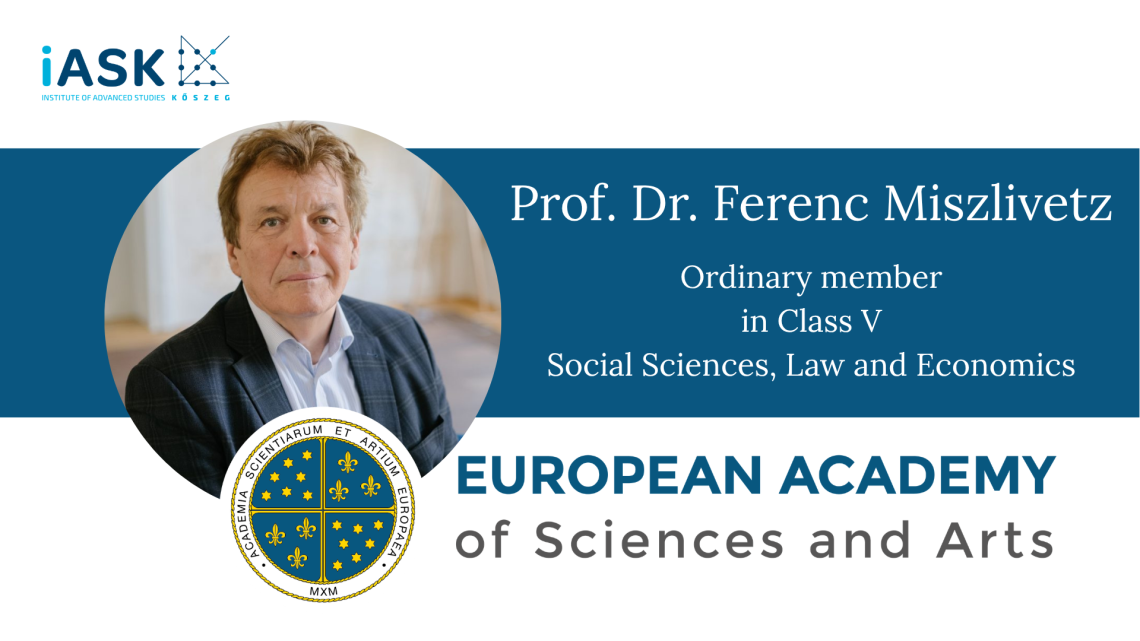
A new prestigious international recognition further strengthens Hungary’s presence in the European scientific landscape: Miszlivetz Ferenc, sociologist and founder and director of the Institute of Advanced Studies Kőszeg, has been elected as an ordinary member of the European Academy of Sciences and Arts on 23 April 2026. The appointment is not only a personal distinction, but also marks another milestone in the international integration of iASK.
Based in Salzburg, the Academy is one of Europe’s most prominent multidisciplinary scientific communities, bringing together nearly 2,000 distinguished scholars, artists, and public figures, including numerous Nobel laureates. Its mission is to build bridges between disciplines, countries, and ways of thinking, while addressing the most complex challenges facing the continent.
Several prominent Hungarian scientists, artists, and scholars are members of the European Academy of Sciences and Arts (EASA), based in Salzburg. Notable members include Ferenc Glatz, Péter Szalay, Gábor Náray-Szabó, Imre Kacskovics, and Ferenc Miszlivetz. EASA brings together over 2,000 top experts, including numerous Nobel Laureates, to promote academic collaboration across Europe.
The EASA is organized into seven classes: Humanities, Medicine, Arts, Natural Sciences, Social Sciences/Law/Economics, Technical/Environmental Sciences, and World Religions.
While the membership represents an individual achievement, its impact extends far beyond the personal level. Miszlivetz Ferenc has been elected to Class V (Social Sciences, Law and Economics), which also means that iASK, under his leadership, will gain more direct access to one of Europe’s most influential scientific networks. From a strategic perspective, this development reflects the conscious internationalization efforts of iASK over recent years, positioning it today as an intellectual hub capable of contributing to global-level thinking.
That an institute based in Kőszeg has built such a high-level network highlights a defining feature of iASK: geographically situated on the periphery, yet increasingly central in intellectual terms. From its inception, the institute has aimed to interpret the key social, economic, and environmental challenges of the 21st century through interdisciplinary dialogue. This new academic membership validates these efforts and opens up new dimensions for collaboration.
Membership in the European Academy of Sciences and Arts is not merely a matter of prestige; the Academy functions as an active scientific and policy-oriented platform. Its members include former heads of state, decision-makers, and leading researchers, creating unique opportunities at the intersection of science and public policy. Through Miszlivetz Ferenc’s membership, iASK is positioned not only to participate in these processes, but also to contribute to shaping them.
The membership will formally take effect upon completion of the admission process, with the official inauguration scheduled for March 2027 in Salzburg.
The key question, however, is not what this recognition represents, but how it can be leveraged. For iASK, it clearly opens new pathways: towards international research collaborations, engagement in high-level scientific and policy dialogues, and a stronger, more visible European presence.
In recent years, iASK has consistently worked to position itself not only as a participant, but as a contributor to international scientific discourse. This membership stands as a visible and significant outcome of that strategic direction.