
Research & Studies
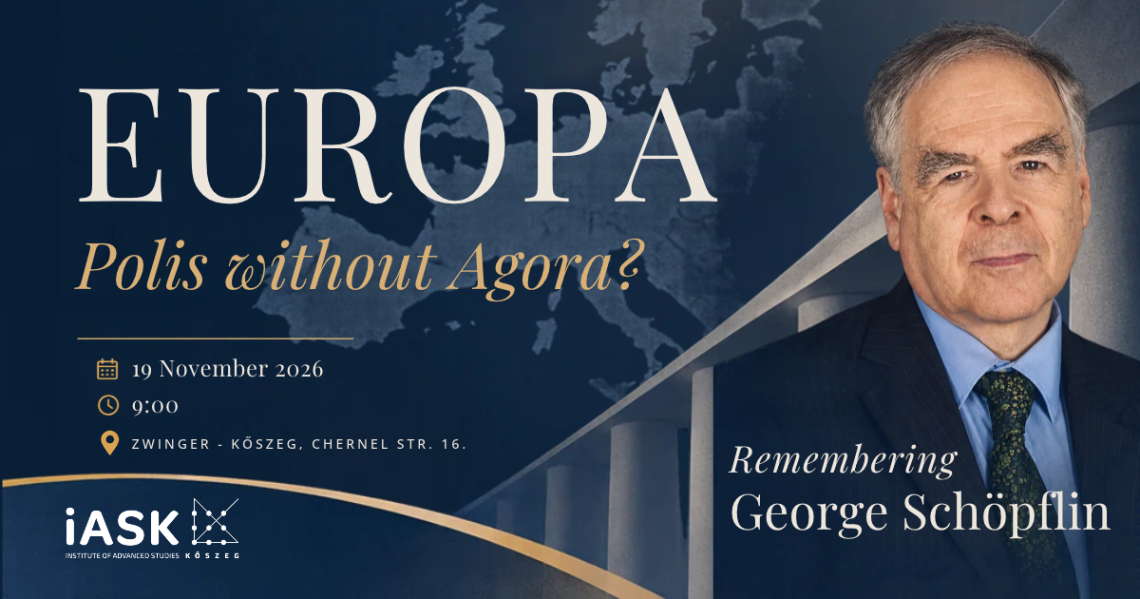
The Hankiss Archive at the Institute of Advanced Studies Kőszeg (iASK) held a commemorative symposium, Europe without Agora? Remembering George Schöpflin, at the Zwinger in Kőszeg. The day brought together scholars from Hungary and abroad to discuss the work of the political scientist, historian and former Member of the European Parliament (1939–2021).
The title of the symposium posed a question that ran through the day: can Europe function without a genuine agora, a shared public space where citizens, institutions and different historical experiences meet as equals? Speakers discussed how Schöpflin described the relationship between Central Europe and the rest of the continent, and what his work can tell us about democracy, public debate and mutual understanding in Europe today.
The morning session looked at Schöpflin as a thinker and public figure. Attila Pók described him as an “engaged intellectual”: someone committed to a political community who keeps critical distance from power. Pók set this against the figure of the “captive mind” in Czesław Miłosz’s classic work, and ended with Schöpflin’s own warning against moral monism, the temptation to be completely certain of one’s own position.
Ferenc Hörcher followed Schöpflin’s path through Budapest, Britain, Tallinn and Brussels, and asked whether Schöpflin himself changed over the years or the political landscape moved around him. He also presented Schöpflin’s idea that Central Europe and the West have often misunderstood each other, because Western democratic concepts reached the region without the cultural background they came with.
György Csepeli called Schöpflin a “radical conservative” and spoke of the “sunken Atlantis of Hungarian conservatism”. He closed on a hopeful note, arguing that Central Europe’s creativity and critical thinking are an asset for Europe as a whole.
Other contributions came from Emil Brix, and Mónika Mátay. Mátay linked the symposium’s theme to Schöpflin’s work on the European Parliament’s Citizens’ Agora and to historical moments when people claimed a public voice, from 1848 and 1956 to Gdańsk and Prague.
Izabella Agárdi presented Navigating Troubled Waters, the volume edited by Ferenc Miszlivetz and Attila Pók in Schöpflin’s honour, and discussed how its arguments about governance, inequality and solidarity look today.
Veronika Kovács traced how Schöpflin’s thinking developed over three decades, from Central Europe as a historically constructed identity to his late critique of the EU. She closed with a question for further research: did Schöpflin change his conception of Central Europe, or did the Europe he defined it against change?
Attila Molnár, archivist of the Hankiss Archive, introduced the Archive’s new structure and some of its “hidden treasures”, including the Schöpflin family materials. Ágnes Széchenyi spoke about the Schöpflin family. The day ended with a round-table discussion introduced by Jody Jensen, with Ahmet Evin, Ljuba Shishelina and Anikó Magasházi as panelists.
The symposium showed that Schöpflin’s questions about identity, political community and the quality of public life remain relevant. The Hankiss Archive will continue to preserve and make available materials related to his work for researchers and the interested public.